
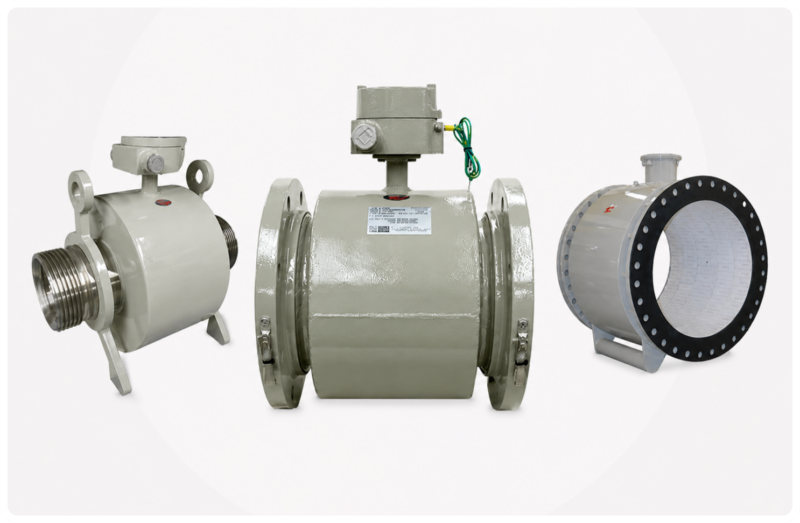
Magnetic flow meters often fail in abrasive slurry applications because suspended solids wear down electrodes and liners, interfere with signal stability, and increase maintenance demands over time. Standard meter designs may work in conductive fluids but often break down in severe slurry service.
The Challenge of Slurry Flow Measurement
Accurate flow measurement is critical in process environments where operators depend on reliable data to maintain control, efficiency, and uptime. In slurry applications, that becomes much more difficult because harsh process conditions can put significant strain on flow measurement equipment and create a gap between expected performance and real-world results.
This challenge appears across industries such as hydraulic fracturing, mining, sand processing, and wastewater, where measurement issues can lead to unreliable readings, increased maintenance, and operational disruption. While magnetic flow meters are commonly used in these environments, many standard designs are not built for the level of wear these applications can create over time.
As a result, operators are often left dealing with inconsistent data, more frequent maintenance cycles, and reduced confidence in their measurement systems – issues that can directly impact process performance and overall operational efficiency.
What Is Abrasive Slurry?
Abrasive slurry is a mixture of liquid and suspended solid particles moving together through a process system. Depending on the application, slurry can vary in solids concentration, particle size, and flow conditions, all of which influence how demanding the environment is on equipment.
What makes slurry abrasive is the presence of hard solids such as sand, silica, minerals, or ash. As these materials move through piping and equipment, they create ongoing friction and wear that can directly affect flow meter performance. This is especially relevant in applications such as hydraulic fracturing sand slurry, mining slurry transport, aggregate processing, and wastewater systems handling solids.
Why Magnetic Flow Meters Fail in Slurry Applications
Magnetic flow meters are widely used for measuring conductive fluids, but slurry applications introduce conditions that go beyond what standard designs are typically built to handle. The presence of suspended solids creates both mechanical stress and signal interference, leading to a mismatch between how these meters are designed to operate and the environments they are placed in.
In abrasive slurry systems, several failure mechanisms commonly occur. Hard particles such as sand or mineral solids can cause gradual wear on electrodes, affecting their ability to maintain consistent signal detection. At the same time, continuous friction from solids moving through the meter can erode internal liners, reducing overall durability. In some cases, material buildup or coating on electrodes can further interfere with measurement accuracy and introduce added variability into the signal.
These issues often develop gradually rather than appearing as an immediate failure. Early on, operators may notice reduced accuracy or inconsistent readings. As wear progresses, performance can continue to decline until the meter requires recalibration, repair, or full replacement. Because this degradation happens over time, the source of the problem may not be obvious until performance is already compromised.
The Impact of Flow Meter Failure
When flow meters begin to fail or lose accuracy, the impact extends well beyond the device itself. In slurry applications, where process conditions are already demanding, even small measurement inconsistencies can reduce visibility into flow rates and make it more difficult for operators to maintain control over critical processes.
As performance declines, maintenance requirements often increase. Meters may need to be inspected, recalibrated, or replaced more frequently, placing additional strain on maintenance and reliability teams. Over time, these repeated interventions can disrupt maintenance schedules and reduce overall system efficiency.
In more demanding environments, such as hydraulic fracturing or slurry transport systems, unreliable flow measurement can also introduce operational risk. Inaccurate data or unexpected equipment issues can contribute to inefficiencies or unplanned downtime in processes where consistency and timing are critical.
These challenges ultimately translate into higher costs. Frequent equipment replacement, increased labor, and the potential for downtime all contribute to a higher total cost of ownership, especially when flow meters are not designed for abrasive slurry conditions.
Real-World Slurry Applications
Slurry flow measurement challenges can vary by operating environment, but the underlying issue remains the same: abrasive solids create conditions that can quickly wear down standard magnetic flow meters. The examples below show how these challenges appear in hydraulic fracturing operations and how longer-lasting flow measurement can improve reliability, uptime, and cost performance.
Hydraulic Fracturing Operations in Alberta
In Alberta hydraulic fracturing operations, blender unit flow meters must measure extremely abrasive sand-water slurries at high velocities while operating in harsh field conditions. In this case, traditional meters were failing every 8 to 9 months due to electrode coating wear, electrode head shear, and polyurethane liner failure, creating repeated downtime and production losses.
Want to see how this application achieved more than five years of continuous operation? Read the Alberta hydraulic fracturing case study.
Permian Basin Pressure Pumping Operations
In the Permian Basin, continuous 24/7 operations, high ambient temperatures, and extremely high proppant volumes created a demanding environment for flow measurement. The case study shows that traditional polyurethane-lined meters with coated electrodes experienced recurring failures, while a single TECO SAM meter went on to process more than 2 billion pounds of sand proppant and remain in service for more than eight years without failure or replacement.
Explore the Permian Basin case study to see how operators improved reliability in high-volume fracturing operations.
ROI in Severe Hydraulic Fracturing Service
In severe-service hydraulic fracturing applications, flow meter performance has a direct impact on maintenance frequency, downtime costs, and total cost of ownership. In TECO’s documented example, replacing meters every 8 to 9 months created significant cost exposure, while the SAM installation eliminated multiple replacements, reduced unplanned downtime, and saved hundreds of thousands of dollars in downtime and equipment expenses.
See how extended meter life translated into long-term cost savings in the ROI case study.
How to Select a Flow Meter for Slurry Applications
Selecting a flow meter for slurry applications is rarely a simple specification decision. Process conditions can vary widely depending on solids concentration, particle size, flow velocity, pressure, and the overall abrasiveness of the media, all of which influence how a meter will perform over time. In severe service environments, a meter that works well in a standard conductive fluid application may not be able to withstand the same level of wear in slurry service.
Because of that, engineers and operators need to look beyond basic flow requirements when evaluating options. Factors such as liner durability, electrode construction, resistance to abrasion, expected maintenance frequency, and the specific demands of the application all play an important role in selecting the right solution. The goal is not just to measure flow, but to maintain measurement reliability in an environment that can quickly wear down equipment that is not built for the job.
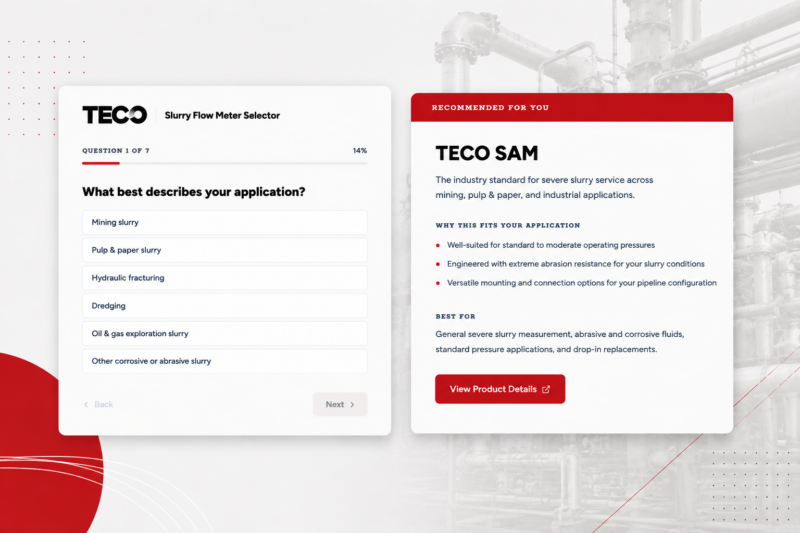
Choosing the wrong flow meter can lead to premature failure, inconsistent readings, and increased maintenance demands that raise the total cost of ownership over time. But evaluating all of these variables manually can be time consuming, especially across a wide range of slurry conditions. To help simplify that process, the slurry flow meter selector tool below allows users to input their application details and receive guidance on the most appropriate solution.
TECO Slurry Flow Meter Selector Tool
Even with a clear understanding of slurry service challenges, narrowing down the right meter can still depend on several application specific details. Pressure range, pipe size, installation type, and service severity can all influence which TECO solution is the best fit.
To help make this evaluation easier, TECO has created a slurry flow meter selector tool that walks users through a short series of application questions. Based on factors like operating pressure, pipe size, installation type, and service conditions, the tool provides a recommended TECO slurry flow meter for the application.
Flow Meters Designed for Abrasive Slurry
Once application conditions are understood, selecting the right flow meter comes down to matching the solution to the severity of the environment. Not all slurry applications place the same demands on equipment, which means different meter designs are required depending on factors like pressure, abrasion level, and overall process conditions.
TECO offers a range of flow meters designed specifically for abrasive slurry environments, each built to address different levels of wear and operating requirements. The options below provide a high-level comparison to help guide selection based on application needs.
| Flow Meter | Best Fit Application | Abrasion Level | Pressure Capability | Key Advantage | Typical Use Cases |
|---|---|---|---|---|---|
| SAM | General abrasive slurry environments | High | Standard to high | Designed for durability and extended service life in slurry conditions | Hydraulic fracturing, slurry transport, general severe service |
| HP SAM | High pressure slurry applications | High | High pressure | Built to withstand elevated pressure and abrasive conditions simultaneously | Pressure pumping, high pressure fracturing systems |
| Brick Lined Severe Application Meter | Extreme abrasion environments | Extreme | Severe conditions | Maximum resistance to wear in the most aggressive slurry environments | Mining, heavy solids handling, highly abrasive processes |
When to Use a Universal Mag Meter Transmitter
While selecting the right flow meter is critical, overall system performance also depends on the transmitter. The TMAX1000 is a universal magnetic flow meter transmitter designed to work with a wide range of existing sensors, giving operators flexibility across both new and installed systems.
Because it is manufacturer-agnostic, the TMAX1000 allows facilities to upgrade performance and extend the life of their current flow measurement infrastructure without replacing existing hardware. This makes it a practical option for operations looking to improve reliability while minimizing disruption and capital investment.
In addition to flexibility, the TMAX1000 provides advanced diagnostics and improved measurement stability, helping maintain accuracy and identify potential issues earlier. It is also well-suited for challenging environments where electrical noise or process variability can affect signal quality.
The TMAX1000 is best used in applications where system flexibility, modernization, and improved performance are priorities, whether supporting slurry flow measurement or more general industrial processes.